Conference talk · 16th EASN International Conference · 27–30 October 2026
Machine Learning-Assisted Multidisciplinary Design Optimization in Aircraft Conceptual Design Using Digital Twin Technology
✓ Presented: 29 October 2026, 14:40 · room 05-114 · Digital Engineering for Aerospace Systems III session · by Melih Yıldız
A full optimization cycle in 5 minutes instead of 1.2 hours, with each prediction's uncertainty stated up front.
Summary
Conceptual design locks in most of an aircraft's life-cycle cost, yet it is the stage where physics-based analysis is used least, because each design point costs too much. Hybrid-electric and hydrogen configurations have no historical data to fall back on, so their design space has to be explored with physics.
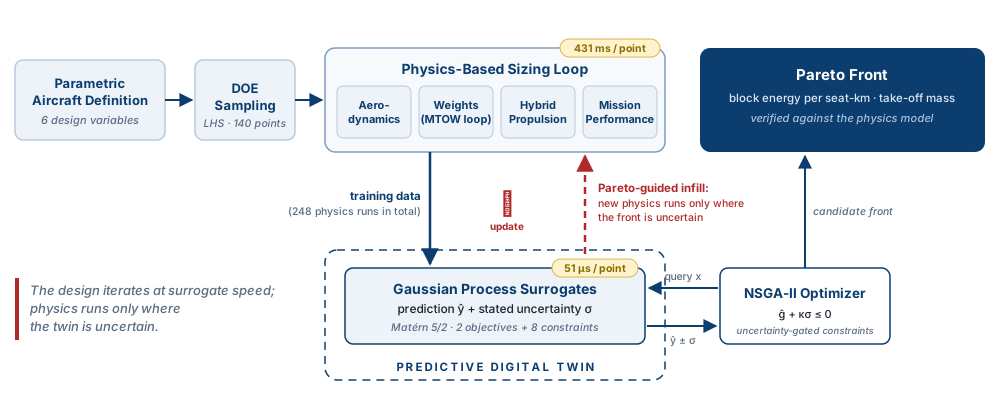
We built a digital twin for this stage: a physics-based sizing loop for a 70-seat hybrid-electric regional aircraft, calibrated against the ATR 72-500, with Gaussian process surrogates and an NSGA-II optimizer on top. Constraints are trusted only when the surrogate is confident, and new physics runs are placed only where the Pareto front is uncertain.
Three findings
- Judge a surrogate where the optimizer uses it. Active learning gives no global accuracy gain over an equal-budget static sample (0.50 % vs 0.48 %), but at the Pareto front its error is 29 times lower (0.03 % vs 0.84 %).
- −10.5 % block energy, fuel and CO₂. Relative to an ATR 72-500 reference that the model reproduces to within 1 %. The gain comes from an aspect ratio of 15.9 and a cruise L/D rising from 14.9 to 16.9.
- Battery specific energy is the gate. At 350 Wh/kg (pack level) the energy optimum is a conventional turboprop. Hybridisation starts to pay above 560 Wh/kg and saves 13.7 % at 1500 Wh/kg.
Measured cost, 70-seat hybrid-electric regional aircraft
| Physics model | This framework | |
|---|---|---|
| One design evaluation | 431 ms | 51 µs (×8 400) |
| Full optimization cycle, all training charged | 1.16 h | 5.0 min (×14) |
| Re-run after a changed requirement | 1.16 h | 44 s |
| Mean error, 120 independent designs | — | 0.50 % |
| Error at the Pareto front | 0.84 % (static) | 0.03 % (×29) |
Companion talk at this conference: Experimental Validation of an Aircraft Digital Twin: From Concept to Validation